
Learn Air
What to look for in an air purifier
HEPA, CADR, room coverage and activated carbon measure different things. Here is how to read the specifications together - and which questions matter before choosing an air purifier.
ZUMA Market Research Desk Last reviewed September 2026
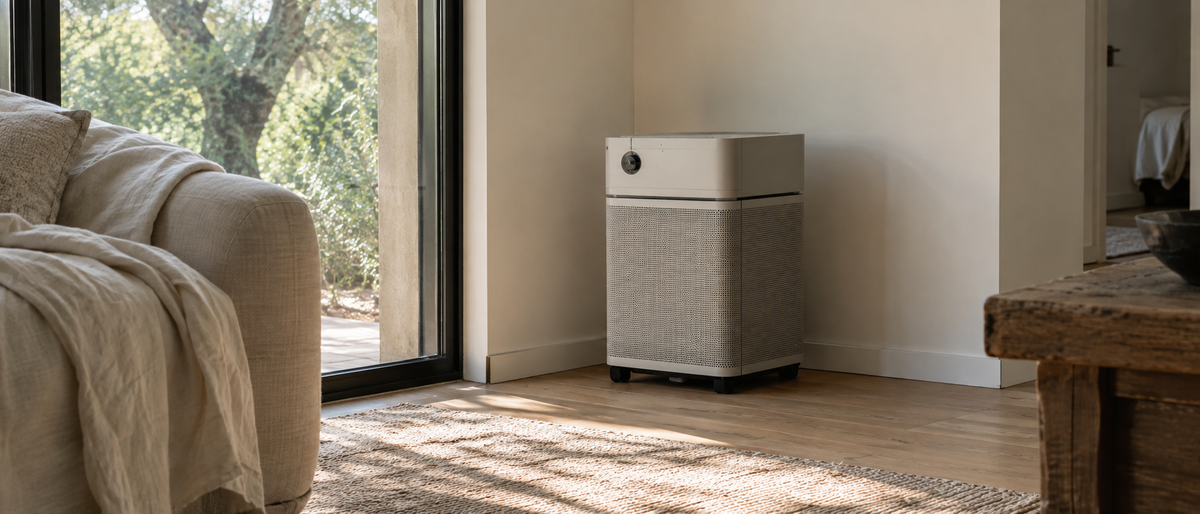
HEPA, H13, CADR, room coverage, activated carbon - air purifier specifications can sound precise while telling you very different things.
Choosing an air purifier is less about finding the most impressive specification and more about understanding how those specifications work together.
Start with four questions: What are you trying to reduce? How much clean air can the purifier deliver in the room where you will use it? What filtration media does it use? And can you realistically run and maintain it over time?
Start with what you're trying to remove
Air pollution is not one single problem, and different filtration technologies address different things.
Particles include dust, pollen, smoke and fine particulate matter such as PM2.5. For these, mechanical filtration and the amount of clean air a purifier can deliver are central to performance.
Gases and VOCs behave differently. They are not captured by particle filters in the same way and generally require sorbent media such as activated carbon.
Some purifiers are designed primarily for particles. Others combine particle filtration with media intended to adsorb certain gases. Understanding which problem you are trying to address makes the rest of the specification sheet much easier to interpret.
HEPA tells you about the filter - not the whole purifier
HEPA describes the performance of a filter, not the performance of an entire air purifier.
In the United States, a HEPA filter is generally defined as a pleated mechanical air filter capable of removing at least 99.97% of airborne particles measuring 0.3 microns in diameter. The often-quoted 0.3-micron figure does not mean that smaller particles simply pass through. It is used as a demanding reference point for filter performance.
You may also see classifications such as H13 or H14. Under relevant international testing frameworks, these describe filtration efficiency at the filter's most penetrating particle size. They can be useful specifications, but a higher filter grade does not automatically mean a more effective air purifier.
The reason is simple: airflow matters too. A highly efficient filter can only clean the air that actually passes through it. When comparing complete purifiers, filter efficiency and airflow need to be considered together.
For particles, CADR is one of the most useful numbers
CADR stands for Clean Air Delivery Rate. It measures how much filtered air a purifier delivers, typically in cubic feet per minute (cfm).
In the AHAM Verifide system, portable air cleaners can receive separate CADR ratings for smoke, dust and pollen. These values combine two things that matter: how effectively particles are removed and how much air moves through the purifier.
For fine particles, smoke CADR is a particularly useful number to look for. It gives you a practical way to compare particle-cleaning performance across different machines without relying only on filter labels or marketing claims.
A purifier with an impressive HEPA specification but insufficient clean-air delivery for the room may still be a poor fit. This is why CADR becomes especially useful when considered alongside room size.
Room coverage needs context
Square-foot coverage claims can be useful, but only when you know what sits behind them.
A purifier does not clean square footage - it cleans a volume of air. Ceiling height therefore matters, as does the amount of clean air the purifier can deliver and how often that air is replaced.
One useful way to think about this is air changes per hour, or ACH - the number of times the purifier can theoretically deliver a room's volume in cleaned air each hour.
For example, a 200-square-foot room with an 8-foot ceiling contains about 1,600 cubic feet of air. Delivering roughly five air changes per hour would require about 133 cfm of clean-air delivery.
This does not mean five ACH is a universal health threshold or that the room's air will literally be replaced five times in perfect cycles. Real-world performance is affected by pollutant sources, ventilation, air mixing, open doors and windows, placement and the fan speed actually being used.
The practical question is therefore not simply "How many square feet does it cover?" but "At what airflow and air-change rate does it cover that space?"
Activated carbon deserves more than a checkbox
Particle filtration is only part of the picture. Gases and volatile organic compounds, or VOCs, require a different approach.
Activated carbon and other sorbent materials work by adsorbing certain gases onto their surface. But seeing "activated carbon" on a specification sheet does not tell you how much gas-removal capacity a purifier actually has.
The amount and type of sorbent matter. So do the pollutant being targeted, airflow through the media, contact time, humidity and how quickly the material becomes saturated.
A thin carbon layer and a substantial bed of sorbent media should not be treated as equivalent simply because both products list activated carbon.
When gas or odor reduction matters, useful questions include: How much sorbent media is present? Which gases has the system been tested against? Under what conditions? And how often is the media expected to be replaced?
Unlike particle filtration, there is no comparably widespread consumer rating such as CADR that makes gas-removal performance easy to compare across portable air purifiers. That makes the quality and specificity of the supporting evidence particularly important.
Be precise about certifications
Certifications and testing references can be useful, but they do not all tell you the same thing.
AHAM Verifide independently verifies performance measures such as CADR for participating air cleaners. ENERGY STAR focuses primarily on energy efficiency. CARB certification for portable air-cleaning devices in California relates to requirements that include ozone emissions - it should not be interpreted as proof that a purifier removes pollutants effectively.
Similarly, a statement that a product has been "tested to" a particular standard is not necessarily the same as independent certification or verification under that standard.
The useful question is not simply "Is it certified?" but "What exactly does this certification or test verify?"
Treat each claim according to what it actually demonstrates rather than allowing one certification to stand in for the overall performance of the purifier.
Be cautious with technologies that can generate ozone
Some air-cleaning technologies use ionization, electrostatic precipitation, plasma or other electronic processes. Depending on the design, some of these devices can generate ozone as a by-product.
Ozone is a lung irritant, and the U.S. Environmental Protection Agency advises against using ozone generators in occupied spaces.
This does not mean every purifier using electronic technology produces problematic levels of ozone. It does mean that the technology used - and the evidence supporting its emissions profile - deserves attention.
If a purifier uses ionization or another electronic air-cleaning technology, look for clear information about how it works and whether ozone emissions have been independently evaluated.
Noise and maintenance are part of performance
A purifier only helps while it is running, which makes usability part of the performance equation.
Higher fan speeds generally move and filter more air, but they can also produce more noise. If a purifier is too loud to run at the setting needed for the room, its maximum performance on paper may not reflect how it performs in everyday use.
This is especially relevant in bedrooms, nurseries and workspaces, where noise can influence how consistently the purifier is used.
Maintenance matters for the same reason. Filters become loaded over time, and replacement intervals affect both ongoing performance and the real cost of ownership.
Before choosing a purifier, consider replacement frequency, filter availability and long-term replacement cost alongside the purchase price.
The better question is not simply whether a purifier performs well when new, but whether you can realistically run and maintain it as intended over time.
The ZUMA Market check
No single specification tells you whether an air purifier is right for your space. We think the decision becomes clearer when you ask five questions.
-
What am I trying to reduce?
Particles, gases and VOCs require different filtration approaches. -
Can it deliver enough clean air for the actual room?
Look beyond square footage to CADR, room volume and the air-change rate behind the coverage claim. -
What evidence supports each performance claim?
Separate filter specifications, independent verification, certifications and manufacturer claims according to what each actually demonstrates. -
Can I realistically run it at the setting that delivers that performance?
Consider noise and how the purifier will actually be used day to day. -
What will it take to maintain that performance?
Check filter replacement intervals, availability and ongoing cost.
The aim is not to find the purifier with the longest specification sheet. It is to understand whether the filtration system, airflow, room fit and maintenance requirements make sense together.
Air, considered more carefully.
Explore air purifiers selected by ZUMA Market, with filtration, room fit, maintenance and supporting specifications considered together.
EXPLORE AIR PURIFIERS →
Research note
ZUMA Market reviews information from primary regulatory and standards bodies, independent testing frameworks and peer-reviewed research where relevant. Product specifications are evaluated separately from broader evidence about filtration and indoor air quality.